
Murphy's War (1971)
During the last days of World War II, the British Merchant Navy ship Mount Kyle is torpedoed by a German U-Boat off the coast of Venezuela. The crew are subsequently massacred as they abandon ship, leaving one survivor, an Irish engineer named Murphy (Peter O’Toole). After being rescued by Louis Brezon (Philippe Noiret), a caretaker for an oil company which has a pipeline in the area, he is taken to a local missionary medical facility run by Dr. Hayden (Siân Phillips). Upon recovering, Murphy becomes determined to find the U-Boat that sank his ship and seeks revenge. However, as the war is clearly drawing to a close Dr. Hayden is reluctant to help him and tries to dissuade him from his plan as it may endanger the local community. In the meantime, Murphy finds a damaged Grumman J2F Duck floatplane from his ship and salvages it. With the assistance of Louis, he makes some improvised munitions and draws his plans against the Germans.
During the last days of World War II, the British Merchant Navy ship Mount Kyle is torpedoed by a German U-Boat off the coast of Venezuela. The crew are subsequently massacred as they abandon ship, leaving one survivor, an Irish engineer named Murphy (Peter O’Toole). After being rescued by Louis Brezon (Philippe Noiret), a caretaker for an oil company which has a pipeline in the area, he is taken to a local missionary medical facility run by Dr. Hayden (Siân Phillips). Upon recovering, Murphy becomes determined to find the U-Boat that sank his ship and seeks revenge. However, as the war is clearly drawing to a close Dr. Hayden is reluctant to help him and tries to dissuade him from his plan as it may endanger the local community. In the meantime, Murphy finds a damaged Grumman J2F Duck floatplane from his ship and salvages it. With the assistance of Louis, he makes some improvised munitions and draws his plans against the Germans.
I suspect that Murphy’s War was intended to be a minimalist exploration of the old adage “if you devote your life to seeking revenge, first dig two graves”. Written by Stirling Silliphant (The Enforcer, Towering Inferno) and directed by Peter Yates (Bullitt, The Deep and Krull), Murphy’s War teases the audience with several instances of potential narrative depths. What motivates U-Boat Commander Lauchs (Horst Janson) to shoot the crew of the Mount Kyle, as they pose no threat to him or his vessel? Is there a love triangle between Murphy, Dr. Hayden and Louis? Why is Murphy so motivated to destroy the U-Boat, considering he initially comes across as a reluctant seaman with little love for English Officers. There’s even a tenuous reference to the IRA. Is he deranged or honourable? These questions raise some interesting opportunities for the film to explore some timeless cinematic themes.
Sadly, even within the deliberately understated framework of seventies cinema, these elements are woefully neglected, leaving us with a matter of fact story that struggles to fill its 106 minutes running time. It’s all somewhat ponderous and very frustrating when considering the quality of the cast and production. Hence we have lengthy scenes in which Murphy struggles to fly the salvaged seaplane and then later, flying around the Orinoco River searching for his quarry. It’s all beautifully shot by veteran cinematographer, Douglas Slocombe, but it often feels like padding to bolster a story that isn’t anywhere near as deep as it likes to think. The climax of the film and Murphy’s subsequent Pyrrhic victory lacks any dramatic impact because there’s no explanation for his descent into a latter day Captain Ahab. The audience is left to ponder whether it was all worthwhile and I for one, broadly feel that it wasn’t. Considering the pedigree of this production, Murphy’s War should be much better.
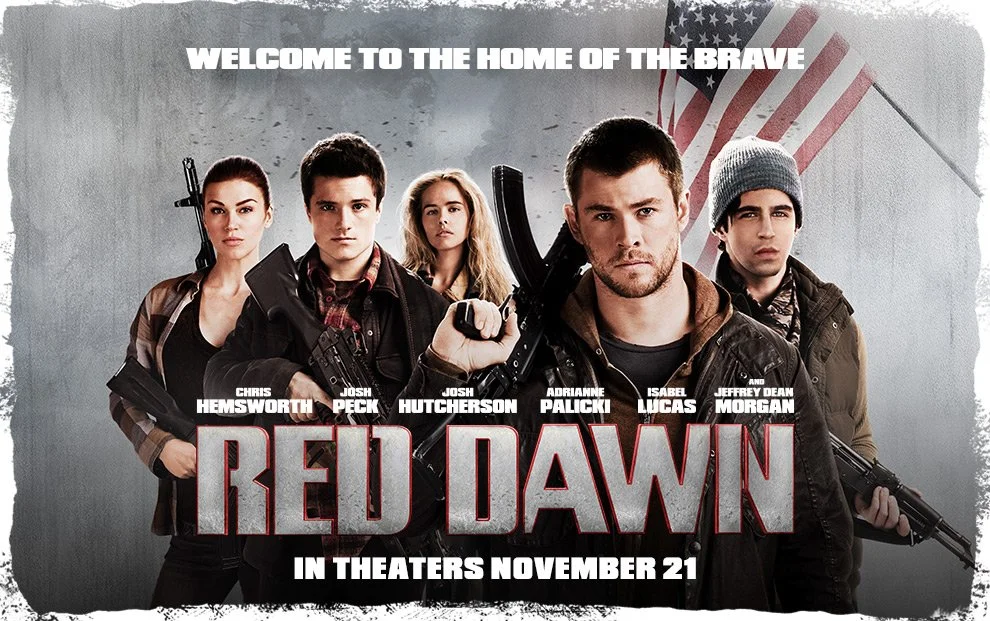
Setting aside the hubris of remaking a film such as Red Dawn, the 2012 reboot had a troubled production. Shot over the course of late 2009, on location in Michigan, MGM intended to release the film in September 2010. However, the studio’s financial problems became unsustainable over the course of that year and the film was shelved, while a financial solution was sought. Furthermore, while Red Dawn was in post production, there was a major economic shift within Hollywood due to the increasing importance of the Chinese market. This was a significant problem for MGM because the new version of Red Dawn had the Chinese invading the USA instead of Russia. Hence there were reshoots and the need for additional visual effects, so that the Chinese could be replaced with North Koreans. MGM eventually went bankrupt and the distribution rights to Red Dawn were sold off. The film was eventually released in 2012.
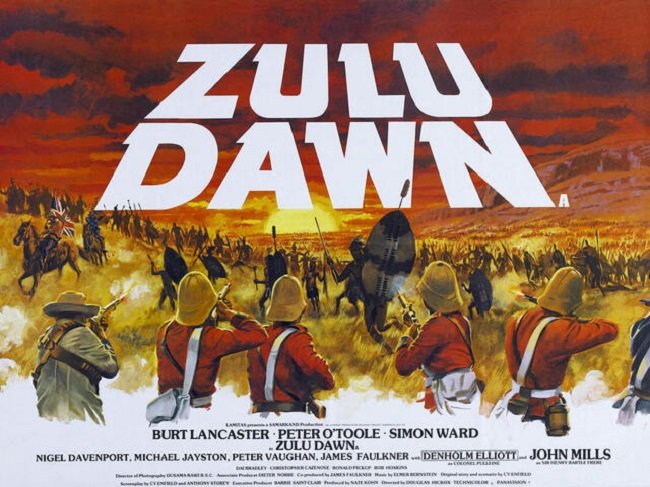
Zulu (1964) recounts the Battle of Rorke’s Drift between the British Army and the Zulus in January 1879. Directed, produced and co-written by Cy Endfield the film presents an action filled account of how 150 British soldiers, 30 of whom were sick and wounded, successfully held off a force of 4,000 Zulu warriors. Although well made and rousing, it is very much a film from the British perspective. Despite depicting the Zulu nation fairly, the film makes no attempt to put the clash between two empires in any sort of wider context. Zulu Dawn is a direct prequel which shows the events that directly lead up to the Battle of Rorke’s Drift. Much more time is dedicated to exploring the Zulu’s position as their leader King Cetshwayo attempts to avoid the political fait accompli he has been presented with. Furthermore, Zulu Dawn does not in any way try to avoid the failure of the British chain of command that resulted in the defeat of 1,300 British soldiers at the Battle of Isandlwana.
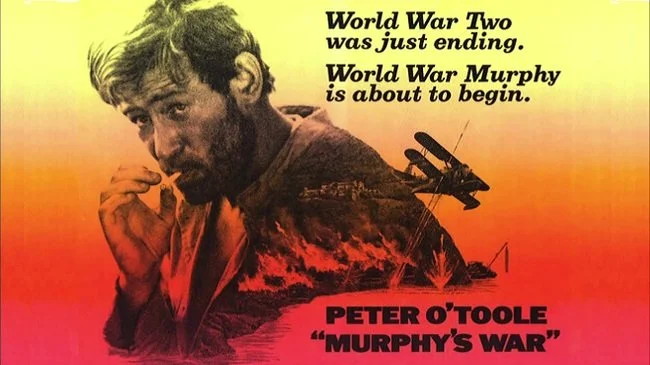
During the last days of World War II, the British Merchant Navy ship Mount Kyle is torpedoed by a German U-Boat off the coast of Venezuela. The crew are subsequently massacred as they abandon ship, leaving one survivor, an Irish engineer named Murphy (Peter O’Toole). After being rescued by Louis Brezon (Philippe Noiret), a caretaker for an oil company which has a pipeline in the area, he is taken to a local missionary medical facility run by Dr. Hayden (Siân Phillips). Upon recovering, Murphy becomes determined to find the U-Boat that sank his ship and seeks revenge. However, as the war is clearly drawing to a close Dr. Hayden is reluctant to help him and tries to dissuade him from his plan as it may endanger the local community. In the meantime, Murphy finds a damaged Grumman J2F Duck floatplane from his ship and salvages it. With the assistance of Louis, he makes some improvised munitions and draws his plans against the Germans.
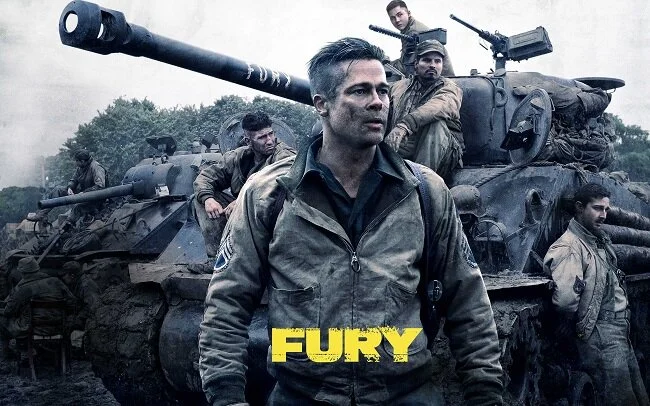
One of the things that immediately strikes you when watching Fury is its credibility and realism. The film reeks of authenticity. Every aspect of the production has been meticulously researched, from uniform and equipment, to ordnance and tactics. The M4A3E8 Sherman tank was not only the workhorse of the US Army but also a home for its five man crew. Director David Ayer makes this idea the foundation of his movie and then proceeds to explore those two perennial themes, the horrors of war and the loss of innocence. The film focuses on the experiences of the crew consisting of Don "Wardaddy" Collier (Brad Pitt), gunner Boyd "Bible" Swan (Shia LeBeouf), loader Grady "Coon-Ass" Travis (Jon Bernthal), and driver Trini "Gordo" Garcia (Michael Peña). They’re a tight knit family, relying on each other to stay alive and keep their mental stability.
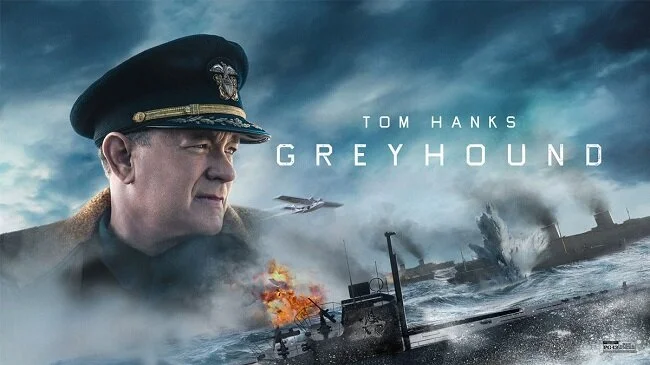
Greyhound is a curious film in that it flies in the face of one’s expectations. When I (and possibly others) see an advertisement or trailer for a World War II movie starring Tom Hanks, I naturally assume that the lead actor has been hired for his prodigious acting talent and that he’ll be providing an in depth character study. I was expecting Greyhound to be the story of an untested US Naval Commander enduring an ordeal by fire on his first escort mission. And that is to a degree what director Aaron Schneider provides but instead of the narrative arc focusing on Ernest Krause’s emotional struggles with his duties, we instead get a docudrama focusing on the technicalities of naval warfare. The latter approach is certainly engaging and at times tense and exciting but this decision narrows the appeal of the film. I personally would have preferred the former.
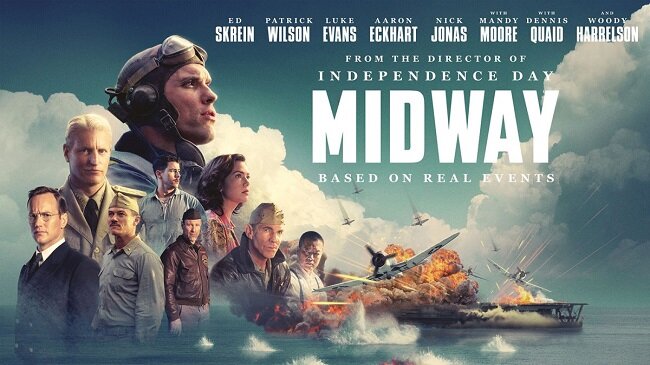
Big budget, historically driven movies that set out to recount key events of World War II are a rarity these days. If you ignore the bombastic inanities of Michael Bay’s Pearl Harbor (2001), then you have to go back to the late seventies to films such as A Bridge Too Far to find a suitable example. This is why Roland Emmerich’s Midway came as a genuine surprise. When I saw a trailer for the film last October, I was flummoxed that such a production had been made. My initial concerns were that it would focus on spectacle rather than historical fact and trivialise events of great military and historical importance. After having watched Midway, I am pleased to report that this is a surprising throwback in many ways. The film covers the events of the Japanese attack on Pearl Harbor, the subsequent Doolittle Raids on Tokyo by the US and the Battle of Midway, both succinctly and accurately. Furthermore, much of the cast play real veterans who participated in these events. Overall this is an entertaining and informative movie that feels like a relic from fifty years ago. However, its docudrama aspirations also make for somewhat generic character development.

It was hardly surprising that the movie adaptation of Chris Kyle's autobiography American Sniper, would cause controversy. The Iraq war, US Foreign Policy and national pride are seldom subjects that are discussed in a calm and measured fashion. And then there are the personal politics of director Clint Eastwood to consider. Hence there were claims from some quarters upon the movie’s release, that it was Islamophobic and counter claims that criticisms of the late Chris Kyle were unpatriotic. There still remain issues regarding the authenticity of events depicted in the source text and subsequently the movies screenplay by Jason Hall. Yet none of these factors have in anyway impacted upon the film's box office returns which currently stands at $247,900,417 worldwide.
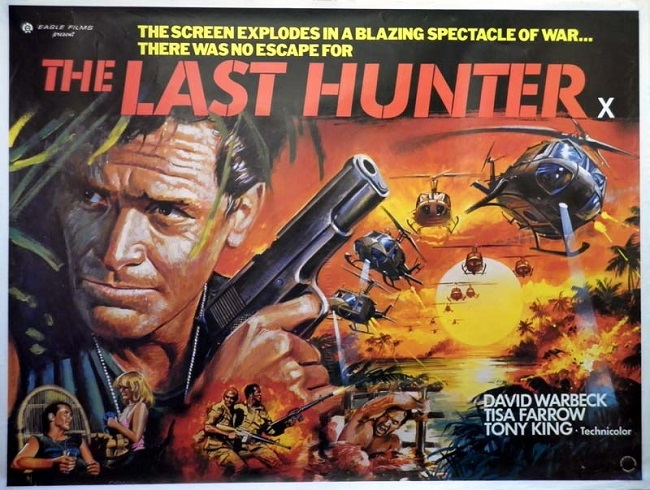
There are many films about war. There are many films about the Vietnam war. A few have transcended mere historical depiction and managed to capture the utter horror and political insanity of the situation, along with the tragic human cost. And then there are those which simply seek to use the setting as a vehicle for an exploitation movie, in the hope of making a fast buck. The Last Hunter (L'ultimo cacciatore) falls firmly into the second camp. This Italian "macaroni combat" movie (yes, I didn’t know that’s a thing either) offers a straight forward tale of an incursion behind enemy lines by an officer charged with destroying a radio transmitter, broadcasting anti-US propaganda. It is violent, action packed and surprisingly honest about what sort of film it is. You’ll find no pretentious philosophical musings here. Just explosions, rotting corpses and Viet Cong booby traps.
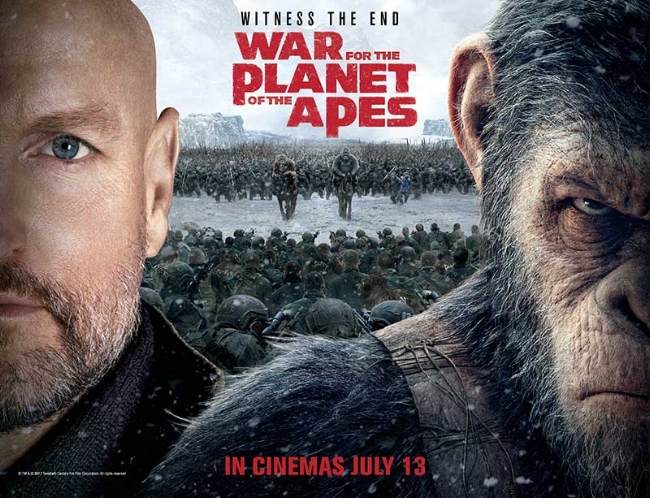
There are times when watching the third instalment of the contemporary Planet of the Apes franchise that you feel like your experiencing something akin to Terrence Malick's The Thin Red Line. There is a narrative depth and an intelligence to the screenplay that you seldom see these days coming from a major studio production. As with the original movies, the story makes multiple subtle points about the nature of humanity and our self-destructive tendencies. Yet it’s all done in a thought full and measured fashion. If you wish to treat War for the Planet of the Apes as simply a science fiction action movie then you will certainly be provided with such a film. However, if you choose to engage your intellect and ponder some of the deeper aspects of the story you’ll be rewarded with much more.
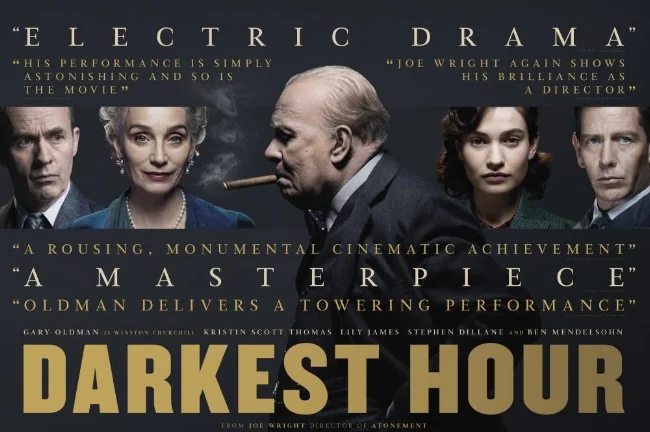
Darkest Hour, unlike many other biopics, focuses specifically on the initial weeks of Winston Churchill’s first term of office as Prime Minister, in May 1940. It paints a picture of an unwanted leader who inherits the role due to political expediency, rather than through universal support. Considered by the King as a dangerous adventurer and overshadowed by previous policy failures such as the Gallipoli landings and the Indian famine, Churchill is without allies and under pressure to appease the Germans. Director Joe Wright, sets the pieces on the chess board succinctly and within a few minutes audiences are brought up to speed with the prevailing historical situation. It is against this setting that that Darkest Hour then explores Churchills uphill struggle to rally a nation that appears to have no appetite for war and fend off political assassination. With the imminent defeat of the British Army in France and the prospect of a humiliating surrender at Dunkirk, should he seek a negotiated settlement with Germany, via Italian diplomatic sources?
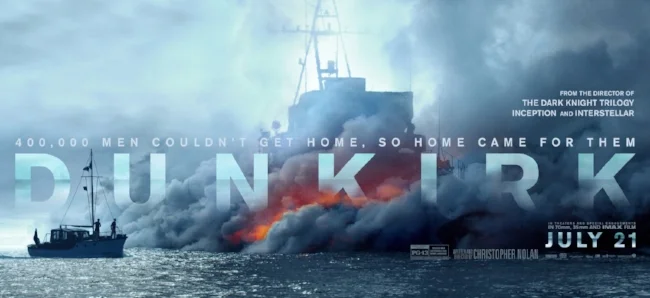
Dunkirk is an extraordinary war movie, that eschews the traditional sprawling format of its predecessors, filled with celebrity cameos and contrived expositionary dialogue. Instead Christopher Nolan manages to embrace the concept of “show, don’t tell”, yet uses what little dialogue he has to succinctly punctuate the unfolding story with emotion and gravitas. There is a sense of spectacle, yet it is far from the stark and dispassionate CGI we usually see. Through creative and focused editing Nolan generates a palpable sense of tension, be it in the air with extraordinary aerial dogfights or on the ground as men flee sinking ships and dodge artillery fire. Dunkirk facilitates an intense and emotional journey during its lean 106 minute running time. It is altogether a remarkable piece of cinema.
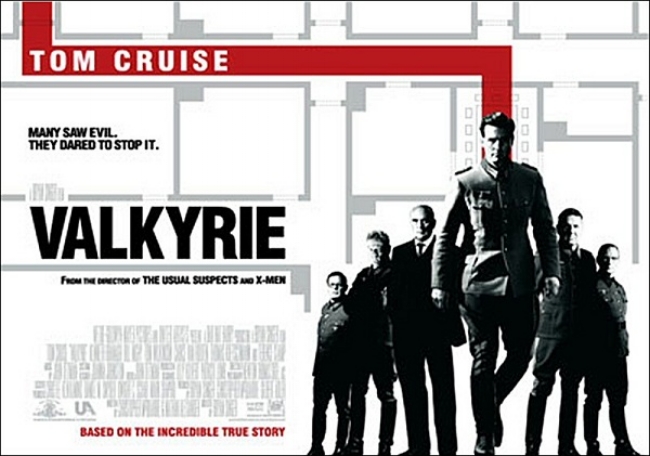
In terms of its production values, Valkyrie is a throwback to the big budget war films of the sixties and seventies. However, that is where the similarities end. This is not a stylised action movie with the Nazis simply as a dramatic foil. Valkyrie focuses on facts, narrative and performances. Director Bryan Singer ensures that the true story that the film depicts is driven by the central characters. Overall Valkyrie is a very laudable production and although not an outstanding feature film, it is competently made, broadly historically accurate whilst and entertaining.
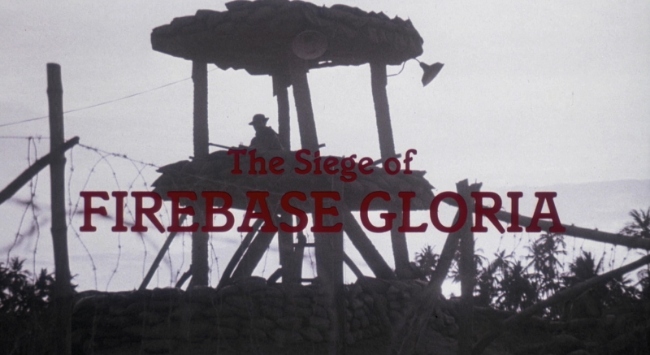
There was a wealth of revisionist Vietnam War films released in the wake of Oliver Stones’ Oscar winning Platoon. Not all were of equal merit or technical competence but occasionally a low budget B movie can surpass the big studio competition. The Siege of Firebase Gloria is one such example, being a minimalist, straightforward film about US Marines defending an isolated outpost in Vietnam, during the Tet offensive. Directed by British expatriate Brain Trenchard-Smith and starring R. Lee Ermey, Wings Hauser and Albert Popwell ("Hey, I've gots to know!"), it’s often been overlooked. However it’s low key plot which seeks no more than to show a small facet of the war, sheds more light upon the overall war and a soldier’s life than one would expect from such a modest production.
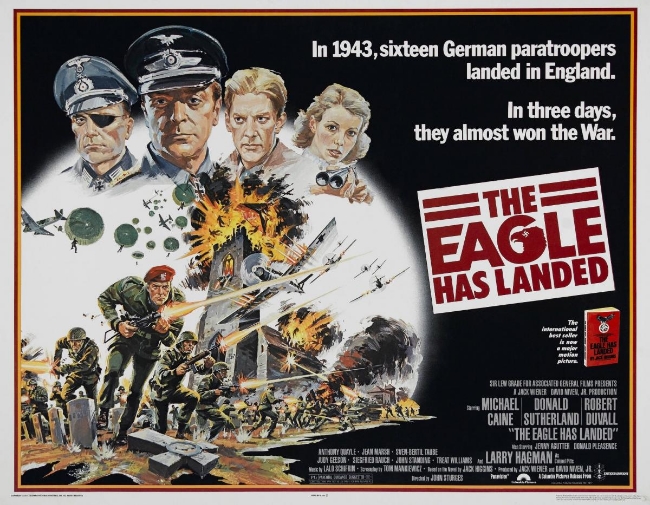
The Eagle Has Landed was veteran director John Sturges' final movie, whose body of work includes such classics as Bad Day at Black Rock, The Magnificent Seven and The Great Escape. Based on the bestselling book by Jack Higgins and adapted by Tom Mankiewicz, the film is a curious beast. It’s an in-depth character driven drama you would expect from such a veteran director, with the succinct and violent action scenes that were prevalent during the seventies. Although the phrase “they don’t make them like that anymore” is somewhat of a cliché, it is quite apt in the case of The Eagle Has Landed. Many of the crew as well as the producers hailed from the golden age of Hollywood.
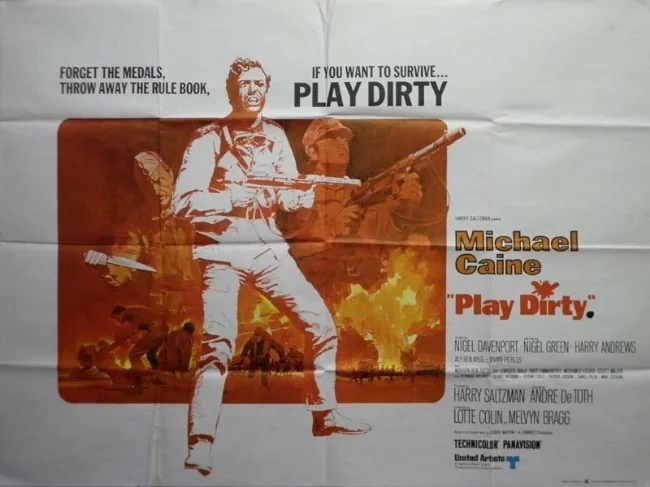
Gritty, grim and fatalistic are just a few of the ways I would describe Play Dirty. Made at a time when cinema was becoming more realistic and cynical, it eschews the traditional depiction of World War II heroism and paints a singularly unglamorous picture. Due to some minor plot similarities, it is frequently compared to The Dirty Dozen but they are far from identical movies. Robert Aldrich’s film despite having an offbeat plot and a cast of quality characters actors still followed a traditional action based formula and had a relatively upbeat ending. Play Dirty is content to pursue its dour storyline to its inevitable conclusion.
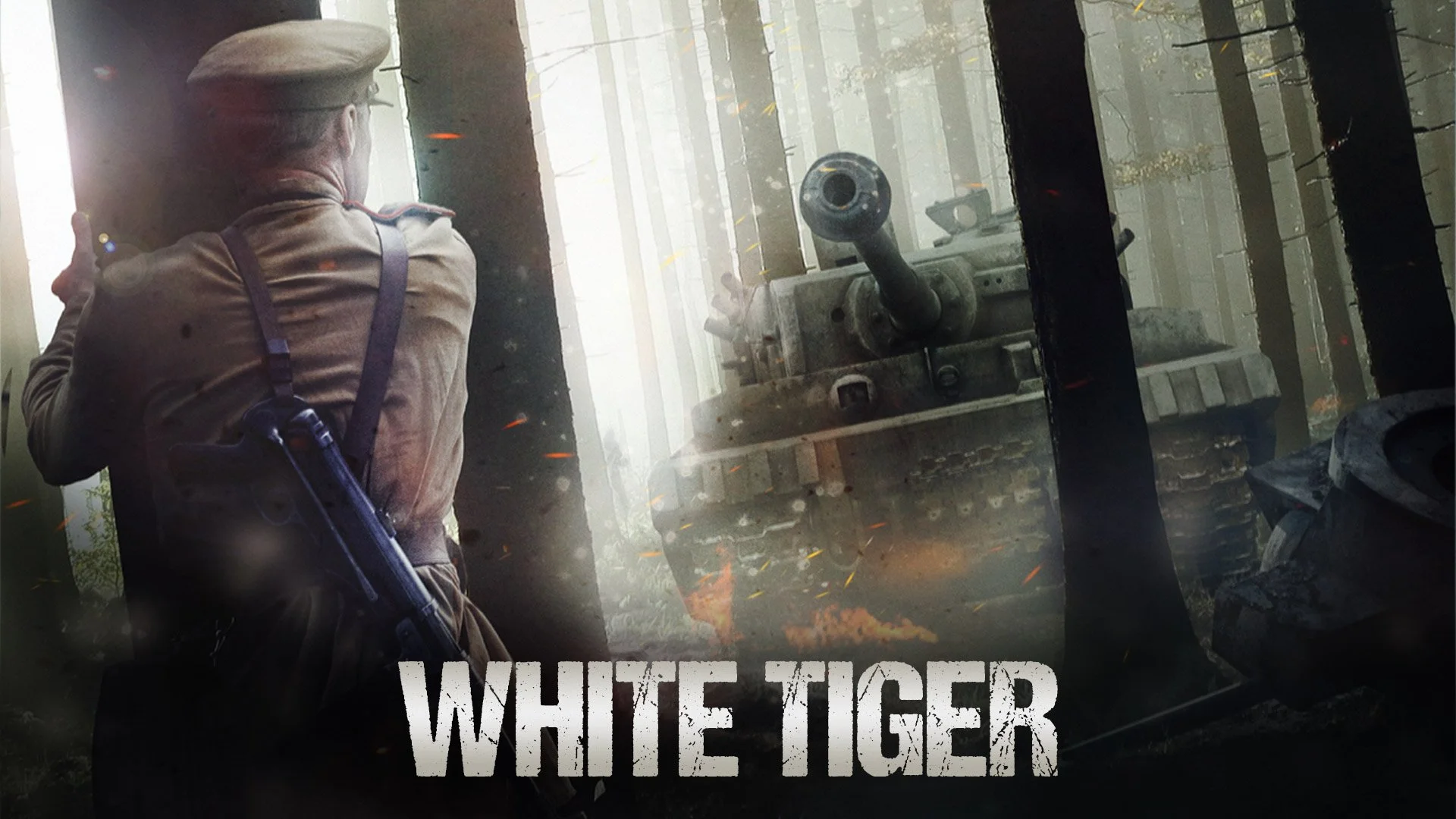
It is rewarding to find a movie that wrong-foots you and challenges your perceptions on certain subjects. White Tiger is exactly such a film. Starting of as a traditional war movie, the story quickly evolves into a supernatural revenge story with shades of Moby Dick. The final act and subsequent sting in the tail ending provides immense food for thought. It proposes an idea that many will find particularly challenging. However the film succeeds in making such a bold pitch because of its inherent Russian earnestness and the fact that that nation’s war experience is so subtly different from others.
On the Eastern Front in 1943, a German Tiger tank crew led by Lieutenant Philip Gerkens (David Schütter) is sent on a mission to rescue the missing officer Paul von Hardenburg (Tilman Strauss) from a top-secret bunker that is at risk of falling into enemy hands. As they make their way through an eerie no-man’s land, they have to avoid Russian armoured vehicles that seem to be aware of their mission. They also encounter a German unit taking punitive action against a peasant village, in reprisal for partisan activity in the area. The youngest crew member, Michel (Yoran Leicher), talks of the land being home to ghosts and spirits. As the tank penetrates further into contested territory the crew become increasingly disturbed by the uncanny nature of their mission and begin to fall prey to their own inner fears.