
Movie Trivia: The Square Song
Steven Spielberg's Close Encounters of The Third Kind is not only a cinematic landmark in science fiction cinema, but a well-crafted exploration of man's compulsion to solve the mysteries of the universe. It is founded on a very seventies notion that there are concepts, ideals and aspirations that are greater than our individual need and that are worth pursuing regardless of any personal sacrifice required. In this instance the film ends with the lead character, Roy Neary (Richard Dreyfuss) happily abandoning his family and the life he has, for the opportunity to be part of something unique and greater than himself. Hence, at the iconic movies climax we see him board the mothership and leave with the aliens. It is a bold and challenging philosophical stance. One that Spielberg has stated he would not now champion, as a father.
Steven Spielberg's Close Encounters of The Third Kind is not only a cinematic landmark in science fiction cinema, but a well-crafted exploration of man's compulsion to solve the mysteries of the universe. It is founded on a very seventies notion that there are concepts, ideals and aspirations that are greater than our individual need and that are worth pursuing regardless of any personal sacrifice required. In this instance the film ends with the lead character, Roy Neary (Richard Dreyfuss) happily abandoning his family and the life he has, for the opportunity to be part of something unique and greater than himself. Hence, at the iconic movies climax we see him board the mothership and leave with the aliens. It is a bold and challenging philosophical stance. One that Spielberg has stated he would not now champion, as a father.
However, I would like to focus on another aspect of the film that has equal gravitas and thematic relevance but has often been neglected by critics and film historians. The specific sequence occurs when child actor, Cary Guffey, is woken at night when all of his toys mysteriously turn themselves on due to the aliens’ electro-magnetic field. Next to his bed is a record player that starts playing "The Square Song". The inclusion of this children’s’ record is this subtle addition to the unfolding events that adds an element of cognitive dissonance to the proceedings. The song which extols the virtues of rational and logical reasoning is juxtaposed against a series of events that defying such quantification. I’m sure that director Steven Spielberg deliberately added this audio embellishment to the scene to heighten the audiences growing sense of unease. It is most unfortunate for viewers that suffer from both xenophobia and squarephobia.
The song itself is a cover version of an original composition, taken from the children's educational TV show, Seasame Street. The version featured in Close Encounters of The Third Kind is by The Pickwick Children's Chorus and was from the album “Sesame Street & Other Children's Pop Hits!” (1970). Sadly, this album is now out of print and the song also doesn’t appear on any version of the movie soundtrack, which is a gross omission. It’s a shame because the cunning use of what is at first glance, just an inconsequential children’s ditty, is in fact another example of the layers of irony and duality that director Spielberg imbues the film with. It should be noted that outside of the context of the film, "The Square Song" is a very powerful piece of work in its own right. I personally have dramatically improved by identification of squares since first listening to it and am no longer mislead by any damn fool rectangle. So here for both your enjoyment and edification is the song presented in its entirety.
Movie Trivia: The Wilhelm Scream
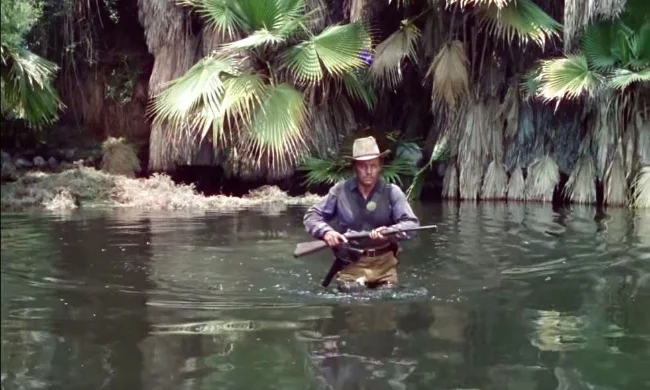
In the 1951 movie Distant Drums starring Gary Cooper, a small band of soldiers are crossing a swamp in pursuit of Seminole Indians. While wading through the Everglades, one unnamed soldier is attacked and dragged underwater by an alligator. His last sound is an agonised, startled scream. Two years later in The Charge at Feather River, a soldier named Private Wilhelm screamed as he’s struck by an arrow in his leg. So began the cinematic legend that is the “Wilhelm Scream”, a sound effect that has punctuated a multitude of films over six decades.
In the 1951 movie Distant Drums starring Gary Cooper, a small band of soldiers are crossing a swamp in pursuit of Seminole Indians. While wading through the Everglades, one unnamed soldier is attacked and dragged underwater by an alligator. His last sound is an agonised, startled scream. Two years later in The Charge at Feather River, a soldier named Private Wilhelm screamed as he’s struck by an arrow in his leg. So began the cinematic legend that is the “Wilhelm Scream”, a sound effect that has punctuated a multitude of films over six decades.
Most studios add audio effects for a film during post-production and of course it’s not unusual for them to recycle material from their archives. In the case of Distant Drums, six short screams were recorded and creatively titled “man getting bit by an alligator, and he screams”. The fifth take was used for the alligator scene and the others were used throughout the rest of the film. Following the movie’s release the distinctive scream was placed in the Warner Bros. sound effects library and used regularly over the years in various productions. It can be heard in Them! (1954), Swiss Family Robinson (1960) and The Green Berets (1968).
Ground breaking sound engineer Ben Burtt noticed the repeated use of the scream during the course of his career. When he made the The Scarlet Blade in 1974 he decided to use the scream, so he cunningly copied it from another film’s soundtrack. Two years later, he was hired to create the sound effects for Star Wars and he managed to track down the original source recording from the Warner Bros. archive. Burtt subsequently began to regularly insert the sound effect into projects he worked on, including the Star Wars sequels. He dubbed it the “Wilhelm scream” in honour of the first named character to use it. The use of the scream rapidly become an in-joke for those in the post production business and from there it use has spread.
The “Wilhelm scream” has been featured in over two hundred movies, TV programs, commercials and video games. Notable film-makers have also specifically requested the “Wilhelm scream” for their movies after learning of its history, including directors such as Quentin Tarantino, Robert Rodriguez, Tobe Hooper, Joe Dante and Peter Jackson. A comprehensive list of titles that incorporate the scream can be found at the IMDB and it’s growing yearly.
The source of the of the “Wilhelm Scream” remains a mystery, but many believe it to be the voice of Sheb Wooley. Wooley is most famous for his song “Purple People Eater”, which was a number-one hit for six weeks in 1958. He had a small part in Distant Drums and was one of a few actors who were called back after filming for some additional dialogue recording. Although he died in 2003 his wife Linda believes it was his scream. She recalls that Sheb was a very gifted voice artist, performing screams, laughs, and other vocals effects for film and TV.
The “Wilhelm Scream” has joined a library of sound effects that are frequently used by sound editors. Others include a thunder clap created for the James Whale’s Frankenstein. Also a particular recording of the red-tailed hawk’s distinctive cry has become ubiquitous in Westerns or any movie with a desert setting. You can also include the universal telephone ring, which has been used on hundreds of films. It would appear that the entire field of audio effects is filled with re-occurring material. Bond films are rife with generic audio effects for automated doors, explosion, electronic devices, jet engines and death screams. A lot of these sound effects seem to have migrated from the back catalogue of Gerry Anderson’s productions.
Like many in jokes, once it becomes too widely known it can lose its impact. The “Wilhelm Scream” is no longer a secret outside of the movie industry and possibly may now have become too ubiquitous. However its history remains interesting like so many obscure facets of the industry. It will interesting to see that as the entertainment industry continues to evolve whether they be equivalents to the “Wilhelm Scream” in five decades times.
Steven Spielberg's Close Encounters of The Third Kind is not only a cinematic landmark in science fiction cinema, but a well-crafted exploration of man's compulsion to solve the mysteries of the universe. It is founded on a very seventies notion that there are concepts, ideals and aspirations that are greater than our individual need and that are worth pursuing regardless of any personal sacrifice required. In this instance the film ends with the lead character, Roy Neary (Richard Dreyfuss) happily abandoning his family and the life he has, for the opportunity to be part of something unique and greater than himself. Hence, at the iconic movies climax we see him board the mothership and leave with the aliens. It is a bold and challenging philosophical stance. One that Spielberg has stated he would not now champion, as a father.